Guide
How to Start a Bounce House Business
Starting a bounce house business is one of the more straightforward ways to get into the event rental world. The equipment is durable, demand repeats every birthday season and you can start with a few units and grow. But the operators who last treat it like a real business from day one: the right units, the right insurance, a real contract and a way to answer customers while you are out on deliveries. This guide walks through the steps in the order most new owners run into them.
This guide is general information, not legal, tax or insurance advice. Requirements vary by state and city, so confirm the rules that apply to you with your state agency, your city, your insurer and an attorney before you take your first booking.
Decide your market and service area
Start by deciding who you want to serve and how far you are willing to drive. Most bounce house businesses start with backyard birthday parties within a set radius of home. That radius matters more than new owners expect, because every delivery costs you time, fuel and wear on your vehicle. A tight service area with a delivery fee past a certain distance is easier to run than taking any job anywhere.
Look at who else rents inflatables in your area and what they offer. Note their delivery areas, their minimum orders and which items seem to book out first. You are not copying them. You are learning what local customers already expect to pay and where the gaps are, such as water slides in summer or toddler units for younger kids.
Choose your first units
Resist the urge to buy a big catalog right away. A few versatile units that fit most backyards will rent more often than one giant specialty piece. A classic bounce house, a combo unit with a slide and one or two add-ons like a concession machine give you enough variety to learn what your market actually books.
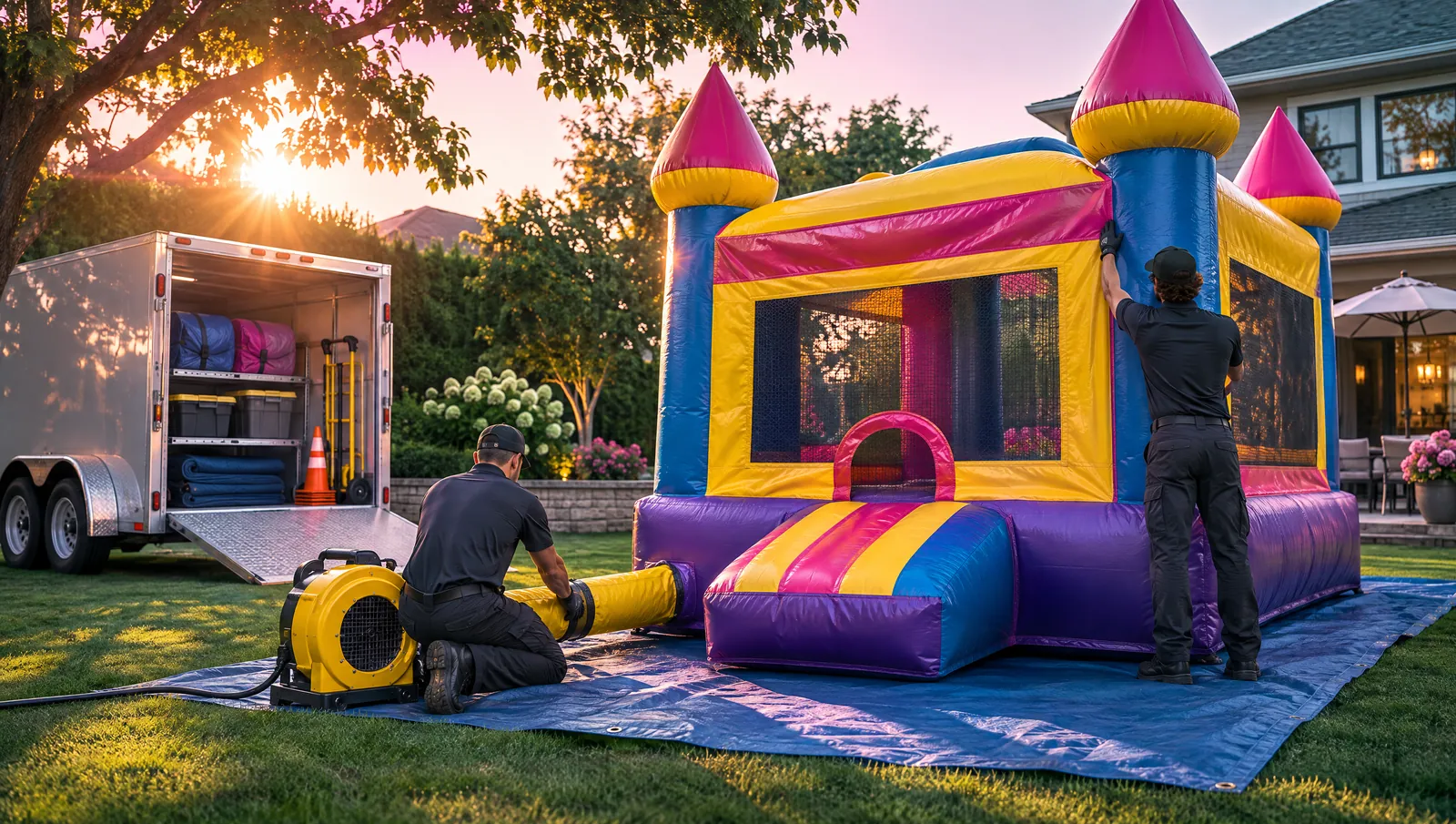
Buy commercial-grade vinyl from established manufacturers. Residential units from retail stores are not built for weekly rentals and will not hold up. Ask about warranty, repair support and replacement parts before you buy. Plan storage before the units arrive: they need a dry space off the ground, and you need a trailer or truck that can haul the weight, plus a dolly, tarps, stakes or sandbags, blowers and extension cords.
Form the business and talk to an accountant
Set up the business properly before money changes hands. Most rental owners form an LLC or another entity to separate business and personal assets, get an EIN, open a business bank account and register for any state or local tax requirements that apply to rentals in their area.
Talk to an accountant early. Rental equipment, vehicles, insurance and marketing all have tax treatment you want set up correctly from the start, and sales tax rules for rentals differ by state. An hour with an accountant now is cheaper than untangling a year of mixed personal and business spending later.
Get insured, and read what the policy excludes
You need commercial general liability insurance that specifically covers inflatables. A generic business policy often does not. Tell the insurer exactly what you rent and how you operate, including whether you deliver and set up, whether customers ever pick up units themselves and whether you ever staff events.
Then read the exclusions. Many inflatable policies exclude or limit water slides, overnight rentals or staffed events, and some exclude specific activities entirely. If something you plan to offer is excluded, either change the plan or find coverage that fits before you book it. Ask your insurer to explain anything unclear in writing.
Check state and local rules
Some states regulate or inspect inflatable amusement devices, and the rules are not the same everywhere. Some cities and parks require permits for setups on public property, and parks often ask for a certificate of insurance naming them before they let you unload. None of this is a reason to avoid the business. It is a reason to make two phone calls before your first booking.
Call your state agency that handles amusement ride or device oversight and ask what applies to rental inflatables. Then call your city and ask about permits, business licensing and park rules. Write down who you spoke with and what they said, and keep your insurance certificate and any permits in the vehicle on delivery day.
Safety and setup basics
The manufacturer's manual is your setup procedure, not a suggestion. Follow it for anchoring, blower requirements, wind limits and supervision rules every single time, even when the yard looks easy. Wind is the hazard new owners underestimate most: know the maximum wind rating for each unit and have a plan for deflating when conditions change.
Cleaning and drying matter as much as anchoring. A unit stored wet grows mildew, smells bad and wears out early. Build drying time into your pickup routine, and inspect seams, anchors and blowers between rentals so a small tear never meets a full party.
Set your prices
Research what local competitors charge for comparable units before you set a number. Most bounce house rentals are priced by the day, with delivery fees that grow by distance and add-ons priced separately. Your price has to cover the delivery time, the cleaning, the insurance and the wear, not just the hours the unit sits in a yard.
Take a deposit to hold the date. A booking without a deposit is a maybe, and maybes collide with real customers who would have paid. Decide your deposit amount, your balance due date and your cancellation terms before your first inquiry, so every customer hears the same answer.
Use a rental agreement and waiver
Every rental needs a written agreement and a liability waiver, signed before setup. The agreement covers the rental period, the price, the deposit, cancellation and weather terms, setup requirements and the customer's responsibilities. The waiver addresses the risk side. Together they set expectations and protect you when something goes wrong.
We put together a separate bounce house rental contract checklist that walks through the sections owners commonly include. Have an attorney in your state review your final agreement, because waiver and liability rules vary by state.
Take bookings and payments online
Let customers book while you work. An online booking page with live inventory shows only what is actually available on the customer's date, because every unit has a stock count. Own two classic bounce houses and both are booked for Saturday? The third request for that Saturday is blocked automatically. No double-booking, no apology calls.
Collect the deposit online at the time of booking through Stripe. The customer commits, the date is held and the payment details stay attached to the order. Add-ons, delivery fees and setup fees belong in the same cart, so the price the customer sees is the price they pay.
Answer calls and messages while you are on a setup
Here is the problem every new owner hits in the first month: the phone rings while you are staking down a slide. A parent asking about next Saturday gets your voicemail, and by the time you call back they have booked with someone else. Weekends are when you are busiest and when customers call most.
This is the part of the business we built Inflatable Agent to cover. The AI receptionist answers every call in your business name, quotes from your real price list and texts a booking and deposit link. The booking page shows only what is actually available for the caller's date. The AI chat agent does the same job in your website chat, text messages and social DMs. Missed-call text back sends a booking link when a call slips through. You keep setting up; the booking still happens.
Marketing basics that actually work for rentals
Set up your Google Business Profile before anything else. Party rental is a local search business, and parents searching for a bounce house near them find companies through Google Maps first. Fill out every field, keep your service area accurate and add photos of your real units set up at real events, not stock images.
Ask every customer for a review after their party, and make it easy with a direct link. Reviews compound: each one makes the next booking more likely. Then stay in touch with past customers. A reminder about 11 months after a birthday party lands right when the next one is being planned, and repeat customers are the cheapest bookings you will ever get.

Put the pieces together
None of these steps is complicated on its own. The operators who struggle are the ones who skip the boring parts: the insurance call, the written agreement, the deposit policy, the system that answers the phone. Do those early and the fun part, delivering parties, stays fun.
When you are ready to take bookings, Inflatable Agent gives you the booking page, the CRM and the AI front desk in one system. Start a free trial and set it up yourself, or book a demo and we will walk you through it.
How to start a bounce house business questions
Stop losing bookings to voicemail
Start your 30-day free trial today. Plans from $99/mo.